Essay · Technology · AI

Browsers Were Designed to Render Pages
— Not Understand Them

And AI is quietly exposing the difference.

8 min read 2025
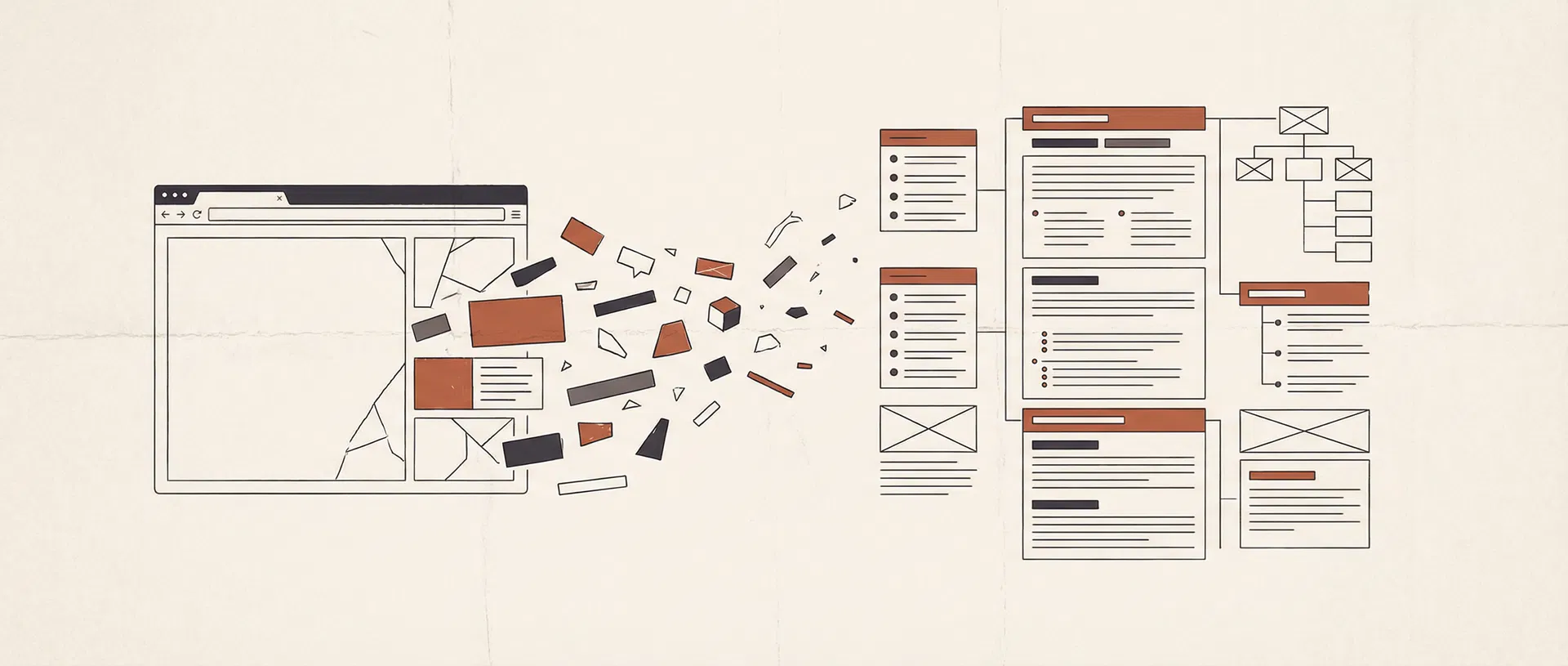
Abstract illustration of a browser window fragmenting into structured semantic data

When I first spent time with modern AI systems, I expected what most engineers expect: another incremental improvement. Faster autocomplete. Slightly better search. Maybe some clever automation.

But after a few minutes working with large language models, something became obvious: they were surprisingly good at working directly with information. Not interfaces. Not menus. Not apps. Information.

And that's when I noticed something odd. The environments we built for humans — especially the web — aren't actually designed for understanding information. They're designed for rendering pages.

That difference matters more than it sounds.

01

The Web Is Incredibly Powerful — and Incredibly Messy

The modern web is one of the most successful platforms ever created. Billions of people use it every day. But if you look closely at how pages are delivered, something strange appears.

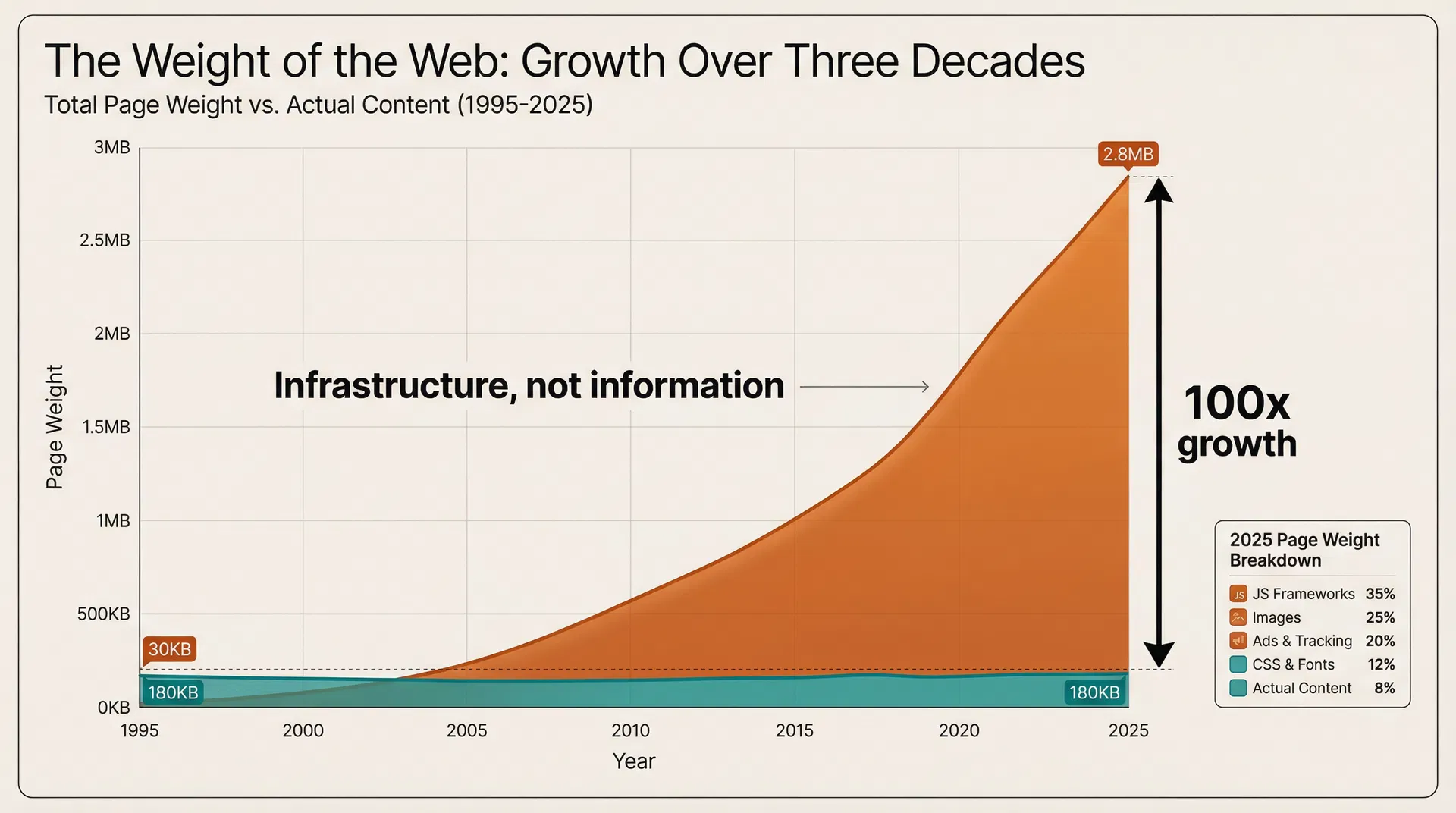
A typical web page today weighs around 2–3 MB on average. In the mid-1990s, it was often under 30 KB. That's roughly 100× growth in page size. Yet the amount of actual information on the page hasn't grown nearly as much. Most of that growth is infrastructure: JavaScript frameworks, analytics scripts, ad networks, tracking pixels, layout engines, and UI libraries.

Chart showing web page weight growing from 30KB in 1995 to 2.8MB in 2025, while actual content remains flat at around 180KB
Fig. 1 — Average page weight has grown roughly 100× since the early web — but much of that growth is infrastructure, not information.

According to the HTTP Archive, modern pages frequently load 20–30 separate scripts and dozens of network requests before a user even sees meaningful content. The browser handles this perfectly. Rendering engines like Blink, WebKit, and Gecko were built for exactly this job.

But rendering and understanding are very different tasks.


02

Rendering vs Understanding

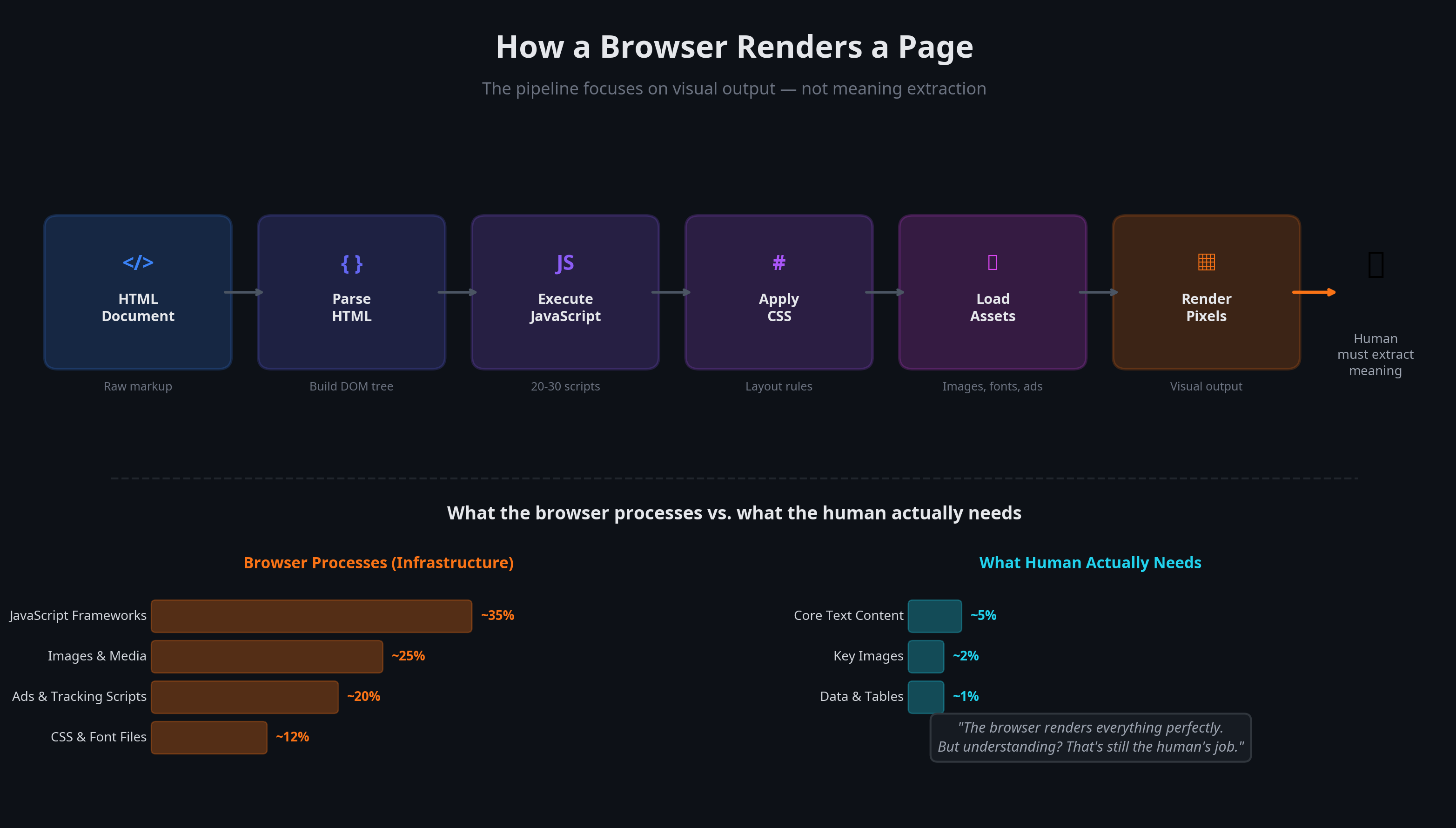
A browser's job is to take a page and make it look correct. It parses HTML. Executes JavaScript. Applies CSS. Loads images, fonts, and ads. And finally produces pixels. Visually, everything works.

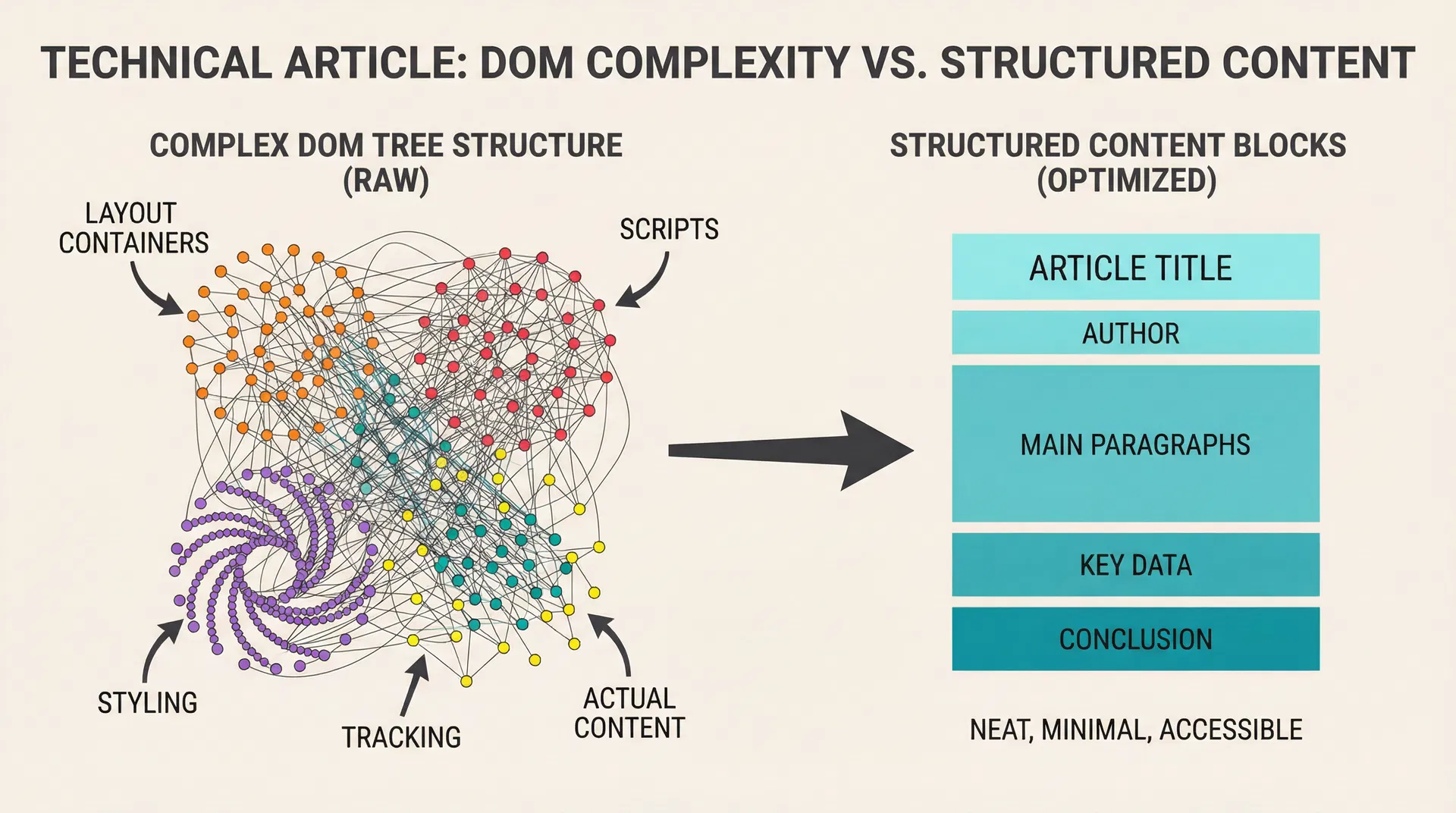
But structurally, the page often looks like this: thousands of nodes, deep nesting, scripts modifying scripts, layout instructions mixed with content. To a browser engine, this is normal. To an AI system trying to understand information, it's chaos.

Diagram showing the browser rendering pipeline: HTML Document to Parse HTML to Execute JavaScript to Apply CSS to Load Assets to Render Pixels, with a human at the end
Fig. 2 — Traditional browsers focus on rendering pages visually. Humans must still extract meaning from the result.
"The browser renders everything perfectly. But understanding? That's still the human's job."

03

Why AI Struggles With the Modern Web

Large language models are excellent at extracting meaning from text and structured data. But the modern web rarely delivers information in clean structures. Instead, meaning is buried inside layout containers, visual styling, nested components, and client-side rendering frameworks.

The actual idea might be a single paragraph hidden inside hundreds of lines of layout code. From an AI perspective, it's like reading a book where every sentence is wrapped inside layers of instructions about fonts, margins, animations, and advertisements.

The model can still work with it — but the environment is fighting it.

Split visualization comparing a complex DOM tree with hundreds of nodes versus clean extracted content blocks
Fig. 3 — A typical web page has ~1,500 DOM nodes. Only ~8% contain meaningful information. AI must extract signal from noise.

04

The Web Optimized for Attention

This didn't happen by accident. Over time, the web evolved around incentives that had little to do with clarity. Pages became optimized for engagement, tracking, advertising, interface complexity, and application frameworks — not necessarily for information density.

Rendering engines adapted to handle this complexity, and they became incredibly good at it. But they were never meant to understand what they were rendering.


05

AI Reveals the Gap

What AI quietly exposes is the difference between two kinds of systems: systems that display information, and systems that work with information. Browsers belong to the first category. Large language models belong to the second.

When those worlds meet, friction appears. A simple article may require downloading megabytes of scripts and layout instructions before the core idea becomes visible. From a human perspective, that's a minor inconvenience. From an AI perspective, it's wasted context.

A simpler mental model: rendering is about appearance. Understanding is about structure. And today, the web overwhelmingly optimizes the first.

06

What Might Change

As AI becomes more capable, the cost of messy environments increases. Not because the models are weak — but because the surrounding systems were never designed for them. We are beginning to see the emergence of tools that extract semantic structure from pages, strip away layout noise, and transform pages into meaning-first representations.

A cleaner environment where the signal is separated from the scaffolding.

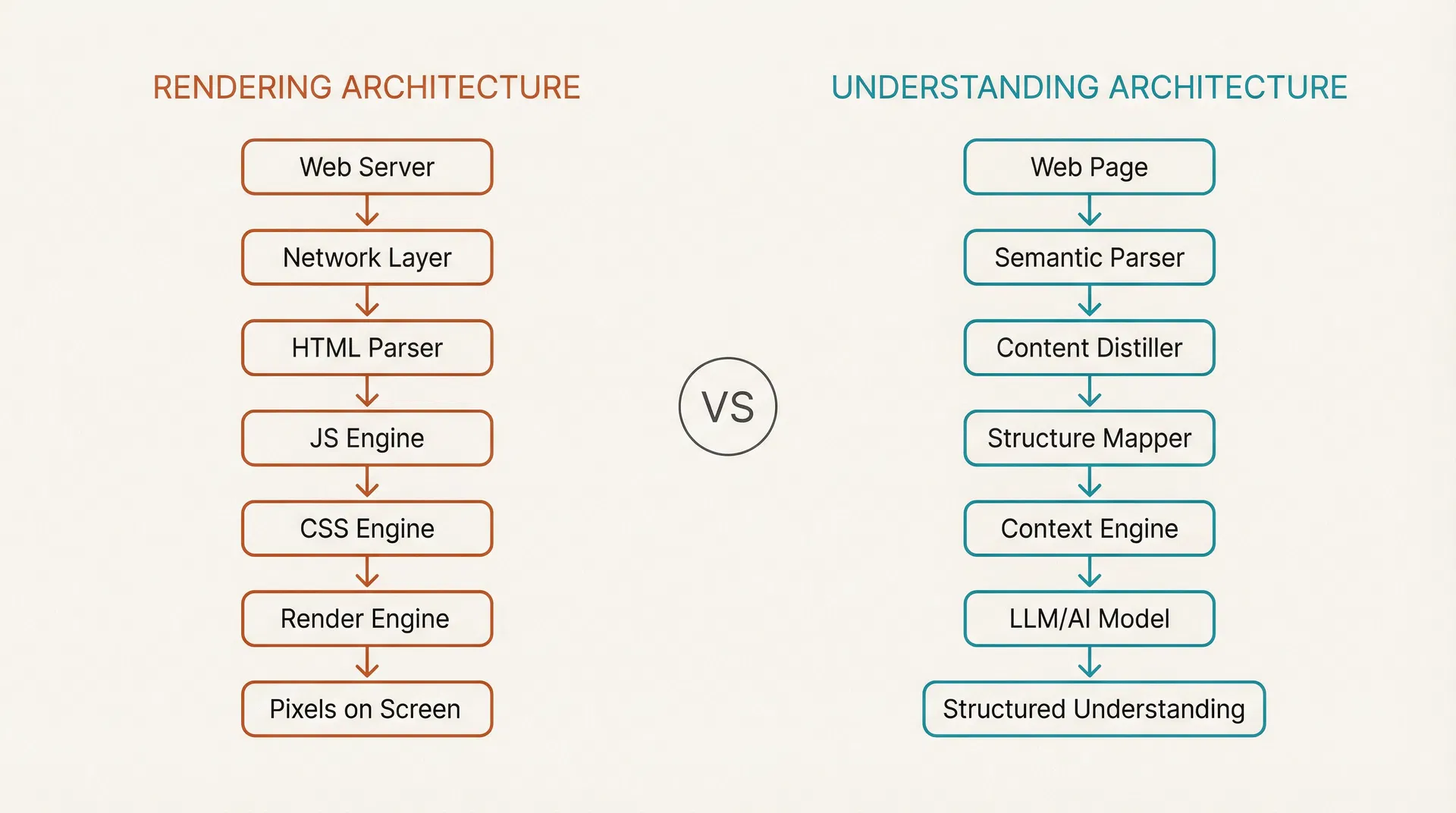
Side-by-side architecture diagram comparing the traditional rendering pipeline with the understanding pipeline
Fig. 4 — Two architectures, two goals. The web was built for the left side. AI needs the right side.

07

The Opportunity

None of this means the web is broken. It means the web was optimized for a different era. Browsers became extraordinary rendering engines because that's what the world needed when the web was primarily visual.

But the next generation of software — AI systems, agents, and intelligent assistants — operates on meaning, context, and structure. That suggests something interesting.

The biggest opportunity may not be building smarter models. It may be building better environments for them to operate in.

08

A Founder's Curiosity

This realization is what led me to start exploring new approaches to browsing and information environments. Not by replacing the web. But by asking a simple question:

What would a browser look like if its primary goal was understanding information instead of rendering pages?

That question turns out to have surprisingly deep implications. For how we read. For how we work. And for how AI will eventually interact with the largest information system humanity has ever built.


The web succeeded because browsers made pages easy to see. The next phase of computing may require systems that make information easy to understand. And that's a different kind of engine entirely.